Native AL Language Server Support in Claude Code
If you’re using Claude Code for Business Central development, you’ve probably noticed that while it’s great at writing AL code, it doesn’t truly understand your project structure. It can’t jump to definitions, find references, or see how your objects relate to each other.
Until now.
I’ve built native AL Language Server Protocol (LSP) integration for Claude Code. This means Claude now has the same code intelligence that VS Code has: symbol awareness, navigation, and structural understanding of your AL codebase.
Wait, didn’t you already do this?
Yes! A few months ago I contributed AL language support to Serena MCP, which brought symbol-aware code editing to Business Central development. Serena works with any MCP-compatible agent: Claude Desktop, Cursor, Cline, and others.
This native Claude Code integration is different. Instead of going through MCP, it hooks directly into Claude Code’s built-in language server support. The result is a more polished, seamless experience specifically for Claude Code users.
Serena MCP: Universal, works everywhere, requires MCP setup Native LSP: Claude Code only, tighter integration, zero-config once installed
If you’re using Claude Code as your primary tool, the native integration is the way to go. If you switch between different AI coding assistants, Serena gives you AL support across all of them.
What is this?
The AL Language Server is the engine behind VS Code’s AL extension. It’s what powers “Go to Definition”, “Find All References”, symbol search, and all the other navigation features you use daily.
By integrating this directly into Claude Code, the AI assistant now has access to:
-
Document symbols: all tables, codeunits, pages, fields, procedures in a file
-
Workspace symbols: search across your entire project
-
Go to Definition: jump to where something is defined
-
Go to Implementation: jump to implementations
-
Find References: see everywhere something is used
-
Hover information: type information and documentation
-
Call hierarchy: see what calls what, incoming and outgoing
-
Multi-project support: workspaces with multiple AL apps work fully
This isn’t regex pattern matching. This is the actual Microsoft AL compiler understanding your code.
Why does this matter?
Without LSP, Claude Code treats your AL files as plain text. It can read them, but it doesn’t understand the relationships between objects. Ask it to “find all places where Customer.”No.” is used” and it has to grep through files hoping to find matches.
With LSP, Claude can ask the language server directly. It knows that Customer is a table, that "No." is a field of type Code[20], and it can find every reference instantly.
The difference is like asking someone to find a book in a library by reading every page versus using the catalog system.
Real example
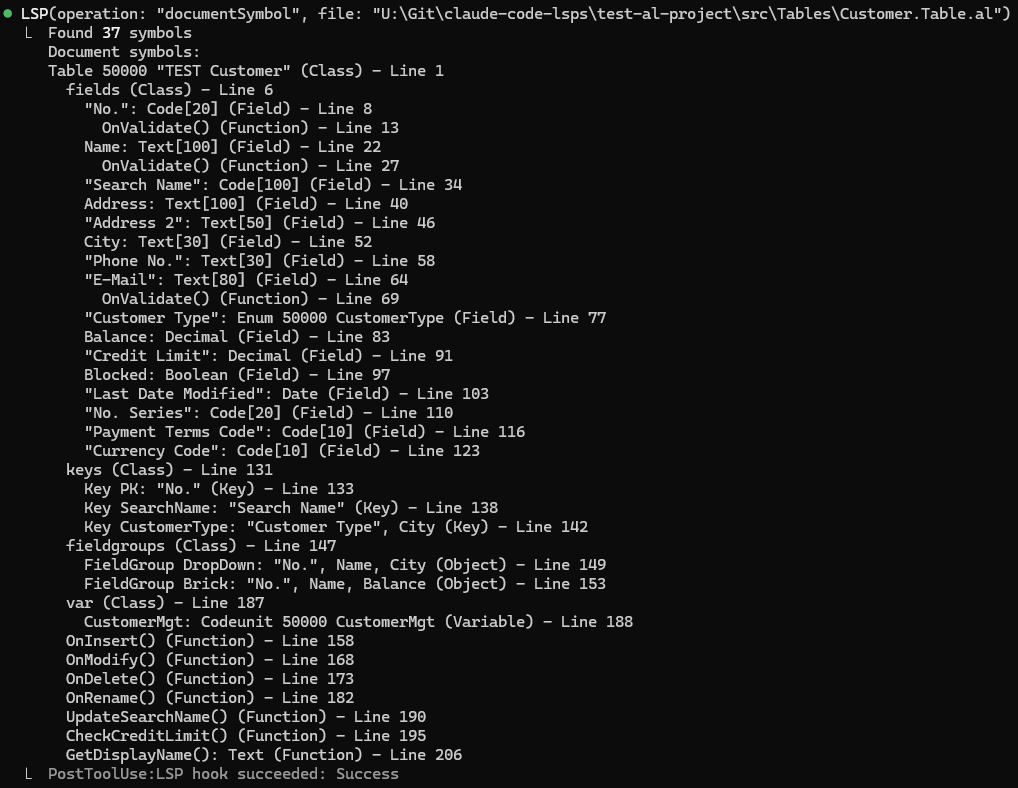
Here’s what Claude Code can do with LSP on a Customer table:
Go To Definition - On CustomerType enum reference at line 77:
→ Defined in CustomerType.Enum.al:1:12

Hover - Same position shows type info:
Enum CustomerType

Document Symbols - Full symbol tree for Customer.Table.al:
Table 50000 "TEST Customer" (Class) - Line 1
  fields (Class) - Line 6
    "No.": Code[20] (Field) - Line 8
      OnValidate() (Function) - Line 13
    Name: Text[100] (Field) - Line 22
    "Customer Type": Enum 50000 CustomerType (Field) - Line 77
    Balance: Decimal (Field) - Line 83
    ...
  keys (Class) - Line 131
    Key PK: "No." (Key) - Line 133
    ...
  OnInsert() (Function) - Line 158
  OnModify() (Function) - Line 168
  UpdateSearchName() (Function) - Line 190
  CheckCreditLimit() (Function) - Line 195
  GetDisplayName(): Text (Function) - Line 206
Every field with its type. Every key with its composition. Every procedure with its line number. Claude can now navigate your code like a developer would.
Requirements
-
Claude Code 2.1.0 or later. Earlier versions have a bug that prevents built-in LSPs from working.
-
VS Code with AL Language extension. The plugin uses Microsoft’s AL Language Server from your VS Code installation.
-
Python 3.10+ in your PATH
-
A Business Central project with standard AL project structure and app.json
Installation
Step 1: Enable LSP Tool
Set the environment variable before starting Claude Code. This is because even as LSPs are now supported, I think they are not production-ready in all instances, hence the active activation:
# PowerShell (current session)
$env:ENABLE_LSP_TOOL = "1"
claude

# PowerShell (permanent)
[Environment]::SetEnvironmentVariable("ENABLE_LSP_TOOL", "1", "User")
# Bash
export ENABLE_LSP_TOOL=1
claude
Step 2: Install the Plugin
-
Run
claude -
/plugin marketplace add SShadowS/claude-code-lsps -
Type
/plugins -
Tab to
Marketplaces -
Select claude-code-lsps
-
Browse plugins
-
Select
al-language-server-pythonwith spacebar -
Press “i” to install
-
Restart Claude Code
That’s it. The plugin automatically finds the newest AL extension version in your VS Code extensions folder.
Repository: github.com/SShadowS/claude-code-lsps
What’s next?
The current wrapper is Python-based. A few things I’m looking at:
-
Go-compiled binaries for faster startup and no runtime dependencies
-
Better error handling for more graceful recovery when the language server hiccups
-
Testing on more setups with different VS Code versions and extension configurations
Try it out and feedback
If you’re doing BC development with Claude Code, give this a try. The difference in code navigation and understanding should be significant.
I’d love to hear your feedback. What works, what doesn’t.
If you make an issue on Github please add the %TEMP%/al-lsp-wrapper.log as it helps me alot during debugging. This file will be disabled in a few weeks, just need it here in the beginning.
Repository: github.com/SShadowS/claude-code-lsps
This is part of my ongoing work on AI tooling for Business Central development. See also: CentralGauge for benchmarking LLMs on AL code, and my MCP servers for BC integration.